2008/09/04

Grab-bag Post

It's been quite a while, dear hypothetical reader. I bring you a variegated bonanza, or rather bonazette, of things.
1. Bits and pieces from the Internets
-I've been loving a series of videos find-able on Youtube called "The Japanese Tradition." Some are subtitled, some not. Best ones I've seen so far: Origami and Hashi (chopsticks).
-If ever your feminist/reasonable side needs a good laugh/cry/fury session, view this little diatribe at your own peril. Apparently the young gentleman attends Columbia, which is horrid (the fact that he's tainting the university, not the university), but then again I can recall certain incidents from my undergraduate career just about as sordid...

2. Books I am reading, books I have read, books I want
-Reading: Changing Clothes in China (pretty sweet so far), A College of Magics (rereading. As Jane Yolen says on the cover of my edition: "A large step up...from Harry Potter.")
-Read: Red China Blues, China Road, Firebirds: An Anthology of Original Fantasy and Science Fiction (Which one of these does not belong?)
AWK! AWWK!

-Should be reading: Pile of material for first week of class (aieeeeee), stack of two dozen books in the corner
-Lusting to read: Guyland, which seems fascinating, not to mention MANLY.

3. Other news
-Making headway in the fairly well-crafted PS3 game Folklore.

The significant other is playing Ellen (young braid-bearing woman whose lack of assertiveness is a bit annoying), and I Keats (spectacle man). It's very interesting how sometimes Europeanisms seems almost more outstanding in Japanese popular culture/imagination than American counterparts. Perhaps some kind of fairly reductive argument could be made about how Europe has more historical and cultural detritus and is thus more appealing to the Asian psyche, laden as the latter is with all that history and, you know, stuff. But it's also important to remember that, as crucial as the relationship between Japan and the US during and since the WWII era has been, that in the nineteenth century Europe was probably much more important as an Other for Japan, whether it be as a kind of enemy in sonno-joi (Expel foreigners, revere the Emperor) movements or as a role model of sorts in industry, government, and military affairs.

2008/08/13

So this is burnout

If I see one more instance of blantant bias in scoring, deliberate falsification, prejudice against one's own citizens, tacky all-we-care-about-is-image pretense, or syrupy enthusing about improvement and progress related to this Olympics thing, I am probably going to explode like a red giant collapsing upon itself.

At least I'm not suffering through the astronomical prices that've been installed for these weeks. Rah rah for foresight in getting the heck outta there.

2008/06/18

Contemporary Stuff (gasp!)

A couple of things related to that ol' favorite of business-minded folk everywhere: China Today.

First, I though Professor Baumler's post, "Chinese History sucks," over at Frog in a Well, was spot-on. I guess it's helpful to some degree that I'm less interested in working on the early periods (motivated, I'd say, in not insignificant part by pragmatic considerations exactly in line with the post--more sources, more "relevance," etc.), yet I feel a bit guilty about it. Who knows, change is possible. But I can't imagine trying to read Han-period texts or seal-script steles. Face explode. Then again, even the Ming-Qing's called "ancient" by some folk (cough certain politics professors of my acquaintance cough), since they predated 1949.

Speaking of sweeping, digit-abundant history, Professor Barnett's Q&A in yesterday's NYT answers some burninatin' questions and points that people in forums from Facebook to the NYT itself have been raising. I especially like this bit:

"Q: Whenever we write about Tibet on this blog, we get many comments from Chinese readers that refer to the Dalai Lama as a slaveholder. What is that about?

RB: First, we can see that as just propaganda that lodges in certain people’s heads, because it’s not even what the Chinese government says. The Chinese government uses the word “serf” — it technically imagines that Tibet is full of serfs, but very few slaves. It was a mistranslation that has circulated and gained some purchase with the Chinese public, including intellectuals, and now they’ve got hold of the slave idea, which was never the case.

The Communist Party sees history in terms of a set number of facts, in this case the party says that 5 percent of Tibetans were aristocrats or landowners, 90 percent were serfs and 5 percent were slaves. I don’t think any of these are actually what you and I would call facts.

[...]

But those laws were made in the 14th century or so and had hardly been used for hundreds of years. But the Chinese cite these old laws, which are really horrendous in writing, and use those as the main basis for these histrionic claims about slavery."

The Chinese suppression of decent scholarship--in content or in method--is horrible, but what's truly disgusting is how history has been reduced to a set of fill-in-the-blank factoids, tinged by nationalism and a staunch refusal to consider alternative points of view, not to mention the totally irresponsible use of sources. And then young intellectuals and bourgeoisie today parrot these tidbits with the greatest pride--which merits the proverb “哭笑不得.”

Issues relating at all to gender and sexuality frequently involve enormous hypocrisies, but the sexual hypocrisy of contemporary Chinese-made history and cultural studies is of course complicated by the whole Marxist-Leninst-Maoist line (in case the dear reader, in hir zest for teh cashz, had forgotten that we're discussing a real live unitary authoritarian government) and its concomitant self-contradictions regarding love, sex, and gender. I'm sure someone learned and wise has written on this somewhere, but why haven't we heard more about these things? Where, O Media, are the more probing inquiries into not just the political or economic oppressiveness of the system, but the crushing effects it has had on people's conceptions of themselves and of the past? No, let's publish yet another story about how materially wealthy those elite young Chinese are, yay! And wow, gee whiz, they're really good at science and math and overseeing semi-illiterate people make shoe bottoms all day, aren't they! Okay, I admit that last one's a bit cheap, and probably motivated in part by my personal grievance with most things numerical, but seriously. So tired of history and culture seeming to take a backseat in these ubiquitous discussions of (mythical narrator voice) China.

Enough ignorant rambling for now. Less of that and more sexies next time!

2008/05/09

Quick Wish-List

Of a few books that I am kind of salivating over, but will probably have to restrain myself from getting until (1) I finish moving across the country and (2) there are more used copies floating around at less retail-level prices.
-Timothy Brooks, Death by a Thousand Cuts: I've always kind of had a thing for grotesque diseases and tortures. I guess that makes me a creepy person...but my goal is of course to become awesome enough to write whole books about my creepinesses.
-Antonia Finnane, Changing Clothes in China: Really shouldn't judge books by their covers, but this one's really stylin'. Should I be put off by the back flap adding "Professor" to Dorothy Ko's name...? Clearly the publisher expects its target reader to have no idea who Ko is. But hey, who am I to dis on more accessible writing?
-Wen-hsin Yeh, Shanghai Splendor: Economic Sentiments and the Making of Modern China, 1843-1849: The cover (yeah, I'm judging by superficials again) promises exciting things to say about advertisements, of which I am inordinately fond. Especially hoping that Prof. Yeh talks about ads for VD cures--intersection between teh sexays and the market economy, the latter of which would otherwise make me headdesk repeatedly from boredom!

But for now, back to work.

2008/05/02

Anal Sex: A 17th-Century How-To Guide

I declared that I would translate a chunk of Bian er chai that describes the mechanics of sodomy in the first post (see below), so I guess I should apologize for holding off so long on it.
[ETA, 19 days later] So I guess I wasn't done being busy. But NOW I AM, so here is the sodomy! Again from the Ming collection by Master Moon-Heart (see below again), more specifically my favorite of the 4 sections, "Chaste Love."

After cleverly weaseling his way into the school at which the lovely but virtuously chaste Zhao Wangsun is studying and falling conveniently ill in order to get the friendly Zhao to join him in his sickbed, the Hanlin scholar Feng Xiang gets his dubious way with the hapless Zhao. After they begin meeting every night, Zhao asks:

"Brother, you say that there's pleasure to be had in doing this, but why is it that I only feel the harshness in it?"
The Hanlin replied, "With you, brother, I'm only going slowly, as if I were water grinding jade. So I only get to enlighten you a little, then must sound the retreat and rest my troops. You've never actually been in the heavenly planes yet."
Zhao said, "There's really a 'heavenly plane' in this?"
Explained the Hanlin, "That place has seven inches that is free of feces. Above these seven inches, there is an orifice, which opens when something enters, or when you are using the bathroom. Otherwise it stays tightly shut. When we're at it, the 'grain tunnel' should be shut tight so that the upper orifice is closed to keep out the filth. In those seven inches, there's also a 'lustful orifice.' After thrusting at it for a thousand times or more, it'll start itching, and the lustful orifice will open by itself, releasing licentious fluids. It's better than words can say. If it hurts, then it must be an amateur doing it. The back door's actually pretty roomy, if you want to see the fun of it, you must go at it a while for the pleasures to start."
Zhao replied, "If that's the case, I must confess my ignorance. I'd like a demonstration, though."*

Whereupon the two lock out the servants and go to it.

For the really curious, everyone in BeC uses spittle for lubricant, and often sodomy is compared to vaginal sex. The phrases "as when a woman tends her husband" or "as if with a woman" come up a-plenty here. There're also a bevy of interesting positions: cowboy, doggy-style, missionary, spoons, etc. And since I heard someone ask the question once, yes, there was kissing, fellatio, and other non-anal activities going on, too. Anal intercourse does seem fairly central, though, particularly in "Chaste Love." (Most of the earlier bottoms were the Hanlin's various servant-boys, and one of Zhao Wangsun's, too.)

But really. A thousand or more thrusts? Are these people 17th-century, nanfeng**-following versions of the Energizer bunny or what?


*My translations are to convey flavor, not necessarily linguistic fidelity, of course. But I gotta say, this is probably the best come-on line ever.
**The pun turns on one of those zillion Chinese homophones. Nanfeng= "Southern Wind (Taste)"/"Male Wind (Taste)"

2008/04/22

This is not a post about pornographic novels or video games

And no, I am not making a Magritte joke, as cool as they are.
I interrupt the torridity of the past few posts, hypothetical reader, with some totally sweet entries from Yuan Mei's Sui Yuan Shi Dan (Food Lists from the Garden of Leisures).*

Some of them are almost as complicated/$$$ as the intricate recipes given in Cao Xueqin's The Dream of Red Mansions, with meat broths flying all over the place, crazy ingredients, and whole days spent stewing:
Sea Delicacies: Three Recipes for Sea Cucumber **
The sea cucumber is a flavorless thing, full of sand and fishy flavor, and is most difficult to pull off well. [Begging the question why anyone would want to attempt to eat it.] Its nature is thick and heavy, so simmering in a broth is out of the question. One must pick out those with smaller spines [clearly a sign from nature reading NOT FOR PEOPLE TO EAT in giant pointy font], soak out the mud and sand, bring them to a rolling boil three times in meat soup, then broil them in chicken and meat stock until they are thoroughly softened. For accompaniment use fragrant mushrooms and wood-ears [Auricula judae]; their black color will match well with the sea cucumber. If one is inviting guests on the morrow, then the cooking must start a day before for the sea cucumber to be completely soft. I've often seen them use mustard-seeds and chicken stock to make sea cucumber salad at Qian Guancha's house, which is very nice. They've also had sea cucumber cut into small pieces and stewed with small pieces of fragrant mushrooms and bamboo shoots in chicken stock. Assistant Secretary Jiang's household uses tofu sheets and shaggy mane mushrooms [NB: they probably grow on your lawn] in stews with sea cucumber, which is also good.

Some are a little more down-to-earth and sound even manageable by yours truly:
Snacks: "Dough Mice"
Use hot water [and flour, presumably] to make some dough, then boil chicken broth and use chopsticks to pinch off and drop in pieces of various size. Add some fresh cabbage hearts for an especially good flavor.

Some are flat-out cute:
Sweets: Roly-Poly Candies
Shaped like go pieces, these come in all colors. The people of Hangzhou give them to children, who think them to be treasures.

And some are crotchety, as befitting a seventy-something "I aced the exams but now I live like a king by writing poetry all day"-type hippie:
Sweets: "Persimmon Cakes"
Persimmon cakes are sweet but boring. I've never eaten a good one, and they're far inferior to tangerine cakes.
This would probably cause YM and my father to have a showdown, because latter thinks persimmon cakes are as unto the nectar of the gods.

Finally, there are some very, very strange entries:
Sea Delicacies: Fish Lips
Fish lips are heavy in texture but pure and light in quality. To retain their peculiar charms, lightly stew in chicken stock.
[A helpful note in the source indicates that YM is referring to "dried food products made from the lip areas of sharks and rays." I never knew these possessed lips--maybe someone played a little trick on zoology-impaired YM here for an extra bit of metaphorical dough. But apparently now I'll get to make really stupid jokes involving cosmetics and cartilaginous fishes!]

Conclusion: chicken stock will cure all ills, be they sandy or probably made-up.


*(See here for the original text.) OMG, major discovery. I've only seen this book rendered as the Sui yüan shih tan before--and I and apparently every other native English speaker to look at this thing (I can't imagine there are too many beside Arthur Waley and Herbert Giles himself) totally thought the tan was the nice, friendly 谈, "discuss" or "talk," but no, it's the much more businesslike 单, "list"! Probably the pervasive desire to cast my homie YM as an über-hip Renaissance Man striking again. ***

**A picture of these little fellers for your edification and/or revulsion:

***A perfectly understandable urge. YM be pimpin' it up, yo (Twelve concubines? Hottest boytoy--uh, protégé-- in town? A poetry school for "moth-eyebrowed" young ladies of good family? Mmm-hm, I think so).

2008/04/14

Historifandom: Musou (Part 2)

After putting up the last installment, I had a discussion with a friend in which he suggested that perhaps I was overemphasizing the fannish appeal of the Musou games, viz. that the majority of players actually savor the games for the intuitive (read: idiotically easy) controls and mechanics, and the fantastic appeal of slaughtering thousands of polygonal enemies, not the satisfaction of seeing historical figures reduced to a delightful hodgepodge of over-the-top visual motifs.

It's probably true that the initial audience for the Musou series were more into das Hackenslashen than the, um, character-slashin', but over the years the game designers' own fannishness toward their heroes have become noticeably more prominent. As evidence I'll follow the evolution of Lu Xun, a general of the kingdom of Wu, historically married to the daughter of Sun Ce and most prominently known for his role in the capture and death of Guan Yu and his victory at the Battle of Yi Ling in 222 (see previous entry). Here he is in Shin Sangoku Musou, known as Dynasty Warriors 2 in the US (released 2000). [NB: The first Dynasty Warriors was a fighting game of the arcade face-off variety.]


And Shin Sangoku Musou 2/DW3 (note the hint of midriff) (2001):


Shin Sangoku 3/DW 4, a swing toward fuller coverage--possibly in tandem with a sweep of conservatism around the world? (2003):


Only to be countered with a decided turn for the bare-all (!) in Shin Sangoku 4/DW5 (2005 ):

And last, not least but probably fruitiest, I present Lord Lu as seen in this year's Shin Sangoku 5/DW6 for the PS3:
And have a closer glimpse of his tres chic eye makeup and feathers:
Certainly the constant improvements in 3D modeling capabilities have contributed to Lord Lu's image updates over the years, but it seems pretty clear that there's something else at work here, namely historifandom and its participants' concomitant power as consumers to actually mold the "canon" of their own fandom. And, since their canon is actually a bunch of characters from historical record reenacting actual events, they are revamping the understanding of history itself through its icons, re-imagining (or distorting, if you're less kindly disposed) the appearances and behavior of the long-dead for their own enjoyment and consumption. When a fan plunks down in 2008 to write a slashfic, would ze prefer a feathery, tribal-eye-tattooed Lord Lu to insert into hir steamy scenes or something more like this:

...they'd probably end up covering the poor fellow in sparkles and feathers anyway. Just like Nobunaga's ridiculous armor in the previous installment, I think Lu Xun's feathers and braids have some "real" roots--he was known as the pacifier of southern "barbarians," and since he hailed from the Eastern Wu (centered in the Jiangnan area), which was already coded as peripheral in the Romance of the Three Kingdoms, the whole exotic look kind of makes sense.* So there seems to be a general "fanon" model for Lu, and it looks a lot more like the Koei rendition--youthful, red-clad, associated with all things flaming (literally). In fact, I've got another indicator that historifandom is in fact going backward to influence corporate-produced canon, that in fact the two are becoming well-nigh inseparable in this our age of high-speed consumption:
[Screenshot from the 2007 show Koutetsu Sangokushi 鋼鉄三国志. Lu Xun on left, Zhuge Liang(!) on right ]

So consumers/fans are actively repatterning history to fit their tastes through popular culture, and apparently with more force than in previous decades. I'd call it Japanese popular culture, but a quick browse at your local chain bookstore or electronics joint will demonstrate that North American consumers are becoming a huge force in gobbling up fandom and fanculture. I do, however, think that the progression of Lu Xun's wardrobe reflects but one dimension of historifandom, that resonate with fangirl/腐女子 ("corrupt girl") culture, with its love of fruity men behaving suspiciously with other fruity men. A somewhat different fannishness has also prompted action on Koei's part--witness the case of Lü Bu, henchie of the warlord Dong Zhuo.

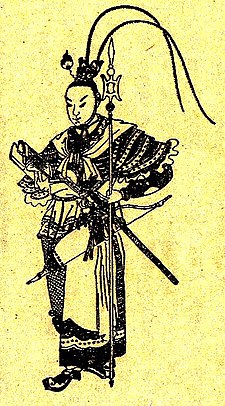
A Qing print, in which Lü looks skinny (according to some, a staple of Qing figurative style). But he's got the mandatory long pheasant feathers and the "Great Sky Slicer" halberd (方天画戟).


Shin Sangoku 2/DW3:
Shin Sangoku 3/DW4, beginning to get a bit darker:
And Shin Sangoku5/DW6, which is just wow(I don't think that's what people meant by "halberd"...):

So what, says the hypothetical reader. These crazy Japanese folks have decided to make more exaggerated costumes, big deal. But there are important differences in how the exaggerations have been made--always with some kind of hearkening to an ur-image or set of motifs based in textual record, but manipulated to cater to as wide a spectrum of historifandom's fan-consumers as possible, a spectrum that is no longer (if it ever was) merely a bunch of Hack 'n' Slash devotees who didn't give a thought what their avatars looked like as long as they could rack up KO counts. And the game isn't all nonstop mook-slaying; cutscenes and cinematics are progressively unlocked as the player slice-n-dices through hordes of enemies, and though the narrative merits of said scenes are questionable, they focus heavily on the heroes' character development (distortionment may be a more accurate term), embedded in historical context delivered by a solemn narrator. For example, Saika Magoichi's opening video.


There's a question worth probing here in relation to non-Asian consumption of the Musou games, which is "how much do American audiences 'get' of the historical stuff," and whether that makes their historifandom one that is weaker than Asian fans, who are presumably more in the know. First of all, of course Asian fans are not necessarily more knowledgeable about obscure, short-lived generals of the 200s CE or random daimyo and their henchmen in 17th-century Japan than are American fans, who may have knowledge sufficient for them to recognize Guan Yu or Hideyoshi and be attracted to the games in the first palace.

Returning to the "Americans aren't historifans" point, when the Musou games first arrived in the US, players were maybe as a whole more content to tolerate weird names and exotic outfits--not exactly something stunningly novel in the game industry--without thinking of them beyond the game, in a way accepting them as culturally "odorless" goods. This may still be the case for some. But the Musou games seem to have also prompted a search for, or at least curiosity in, the very much culturally specific and historically rooted "real" underneath the glossy CGI. For example, the large Koeiwarriors fansite forum (http://z13.invisionfree.com/koeiwarriors/) boasts a special sublevel, the "History Realm," dedicated to "various eras of history"--it's actually got more topics than any one of the other sublevels dedicated to specific titles of the Musou series.

While changing demographics and demands in fandom successfully reshape Koei's Gross Historical Distortion, history (with lesser or greater degrees of Gross Distortion) enters into the consciousness of fans and recalibrates their demands. Intuitively it seems kind of terrible to imagine hordes of 18-35 year-olds contributing to the terror that is Shin Sangoku 5's Lü Bu or Koutetsu Sangokushi's Zhuge Liang, but really, is what the "pros" do so very different? There's money, obsession, and distortion involved in the latter case, too, isn't there? Maybe academic historifandom seems more okay because there's less money and more book-reading entailed. Probably the same obsession, though, and distortions are willfully ignored or ruefully acknowledged, not delighted in and paraded around.

(*I'll need to muse a bit on why Japanese pop culture seems to like Wu so much when Shu, which controlled Sichuan, and the 中原, or Yellow River plain, was the narrative focus of RotK.)