Showing posts with label pictures. Show all posts

2009/06/06

Comic Books, Old School Chinese Style

The term's finally coming to an end, and so I guiltily update a horrifying two months since my last entry. To make up a little for this transgression, I've got some juicy stuff to share.

While doing some poking around in old books earlier this year, I ran across illustrations in some late Ming (early 17th century) gongan xiaoshuo, or "court-case tales." (NB: xiaoshuo is the Modern Chinese word for "fiction," but the fictiveness of the genre in late imperial times was not nearly as clear-cut as that label might imply. Thus I use a zillion synonyms, but never "fiction.")

Anyway, these pictures take up about a third of the page;


(This and all following images from the Mingjng gongan, or Bright Mirror Cases. )

block-printed like the text, they are not exactly the pinnacles of late imperial Chinese artistic genius--in fact, they are frequently quite stereotypical in their graphic vocabulary, with all the women looking like one another, all the magistrates much apparently cloned from one man, etc. Not unlike Lego characters in the recent series of popular films adapted into Lego-based action games, even when these figures' heads are lopped off they retain more or less the same expression--one of slight bemusement:


(Oh dear, it looks like this evil monk, being unable to seduce me, has lopped my head off in his fury. Teehee?)

Nonetheless, the presence of these illustrations suggests something of how the vast majority of Chinese people might have accessed stories that literate folk could read at length in the body of these xiaoshuo. The stereotyped images also have the flavor of the courtroom drama, put on and accessible to even the most "rootless" of illiterate rural people. As one would expect from the Cops of 17th-18th century China, most of the stories are pretty sensational, with lots of blood, sex, and plot twists. Notably, I've found two stories in this collection alone with women who have sex and impregnate each other.

But just about all gonagan xiaoshuo end with the successful, clever resolution of the case by a righteous judge, and, often, most unpleasant punishments for the guilty parties. More than occasionally, these sentences far exceeded the statutory regulations.


(If "a wicked monk buries the woman [he murdered, see above] and plants a tree atop her grave" isn't pretty sensational, then you, dear Reader, have probably watched a little too much true crime TV, especially since the monk is apparently a late Ming version of the Hulk or something, able to uproot entire full-grown trees.)

Here I want to post a complete graphic account of a case so you can pretend to be an illiterate person--little kid, young wife, old codger, bandit--of your choice and follow along, just like an episode of CSI as a comic, except Old and Chinese, which can only make the experience better...right? Thus I present "Lord Governor Chen Solves the Case of a Rape and Murder."


A local gentleman, Deng Kui, treats the scholar son of an acquaintance, Zhang Wenli, to a meal.

(Thebpody text notifies us that Deng Kui's young wife, Yu shi,* is "flowerlike in complexion and moonlike in radiance, more beautiful than Xishi and Imperial oncubine Pan of old, with hands delicate as new-sprung lily-buds and brows as fine as willow-leaves just appearing on the branch." During the Pure Brightness festival, Deng and his old mother go out to pay the customary tributes to his father's grave, leaving Yu shi home alone. BAD IDEA.)


Zhang Ba [Zhang the Eighth] tries to rape Yu shi and, failing to overcome her, murders her.

(The body text describes the young idler Zhang the Eighth, who had long lusted after Yu shi, and, when he saw the young woman's husband and mother-in-law both heading toward the graves on Pure Brightness, decided to make his move. Unfortunately for him, Yu shi shouted invectives at him and tried to flee. Suddenly realizing his difficult situation, and espying some fancy jewelry and cltohs, Zhang the Eighth grabs a kitchen knife, kills the poor Yu shi, and seizes some of the cloths and jewels before running and hiding in the hills behind the house.

Coincidentally, the young scholar Zhang Wenli passes by the Deng household and heads inside to say hello--with the ulterior motive of maybe catching another glimpse of the beautiful Yu shi. He ends up discovering her "corpse, saturated with fresh blood and lying on the floor," which scares the soul from his body. In terror, he leaps on his horse and dashes away. Zhang the Eighth, still crouched in the hill, sees all of this clearly. You may see where this is going.)

Kui returns home, sees his wife's murdered corpse, and begins to weep uncontrollably.

(The mother-in-law and Deng Kui report matters to the local headmen immediately. Zhang the Eighth makes a timely appearance, saying that he had been chopping wood in the hills and had seen Wenli ride in, then leave a short while later in a panic. "His family is rich and just has the one son," Zhang suggests to Deng. "You should take this body and carry it to their door, otherwise they'll probably try to bribe the officials with all they've got."** But Deng is reluctant--the Zhangs might send people out to grab Yu shi's corpse and thus eliminate the evidence, so he takes matters to court.)

Deng Kui turns in a petition to the county magistrate accusing Wenli.

(The text reproduces Deng's accusation as a standard "petition" form--perhaps as a way to satisfy armchair detectives who should have been studying up on the Book of Odes or the Spring and Autumn Annals instead, so they could become a magistrate and read real, but probably much more boring, petitions.)


The magistrate sends out constables to arrest Wenli.

(The magistrate, Shen, is "an impatient and harsh man" equipped with "a steely sense of justice." He's furious after reading the plaint, and straightaway sends off constables. I do like this dude's pose with those manacles--can you hear the Cops theme music in the background here?)

Zhang Shimao, Wenli's dad, sets out some wine and goodies for the two constables.

(The next morning, having deflected the police for the evening, Shimao has Wenli file his own petition, accusing Deng Kui of making false accusations: "last year Deng lent my father some silver as startup capital, which we have not yet repaid. Thus he is plotting to cheat us of money.")

Magistrate Shen conducts the inquest of Yu shi's corpse.

(The corpse has a wound on the side and another on the neck[--this does seem obvious, considering the picture shows her decapitated...]. Magistrate Shen calls in the local headmen and Zhang #8 for interrogations. I wonder what that weasel's going to say?)


Zhang the Eighth stubbornly testifies against Wenli, who is injustly condemned.

(At first resistant to confessing, even after forty strokes of the bamboo rod and collapsing in a faint, Wenli eventually confesses after being trussed up in the leg-press and having his head knocked with sticks. Even though he still denies any knowledge of the clothes and jewels, Magistrate Shen ignores him and writes up a case summary.)
Shimao appeals the case to the Provincial Judicial Commissioner's office.

(There's another "plaint" here recording what Shimao filed on the provincial level, going over the prefect's head.)

Luckily for the hapless Wenli, the Nanjing-based Governor Chen is on a tour of inspection and arrives in Huizhou prefecture at just the right moment.

("A youthful holder of the jinshi degree [the third and most advanced in the bureaucratic tests]," Chen is "bright as a mirror, able to see as clearly as a vase of ice, and careful in the details, down to matters as fine as the new-grown autumn down of birds and beasts.")

The Governor interrogates the murder in detail.

("Lift high the bright mirror, Sir," pleads Wenli, "and shine through my injust condemnation." Zhang #8, though, maintains that he had seen the entire rape-attempt-cum-murder from the hill where he was chopping wood. The Governor asks if he, being at such close range, had heard the woman screaming, which she must've done as her murderer attacked. "This humble person did hear," says Zhang #8. "Well, if you heard her cries, why did you not report the matter, instead waiting for Deng Kui to do so? Your words seem unreliable." Zhang #8 has nothing to say.)

A crow flies in and pecks the head of Zhang the Eighth.

(Just as the Governor is hesitating over Zhang #8's inconsistent testimony, a crow flies right in, pecks Zhang #8 on the head once, then flies off again. Everyone's shocked, until Governor Chen sternly shouts that it was Zhang #8 who had done the deed. The fellow refuses to confess until he's gotten two rounds of the leg-press and a hundred knocks from the sticks. When he finally does admit to his crime, he adds that "Heaven couldn't allow my stubborn accusation and injustice toward Wenli, and now you, Sir, are as just as the blue sky. I am resigned to paying with my life.")

The great Governor sentences Zhang the Eighth to the death penalty.

(The Governator also declares that, because Yu shi had resisted rape to the death, she would be commemorated as a chastity martyr, which probably means some silver distributed to her husband's family to erect a paifang, or arch, and a likely biography in the local gazetteer--though such institutions are much better documented as well as a lot more extensively maintained in the Qing than the late Ming.)


Wenli is cleared of the crime and sent home a free man.

(I dig his jolly look here. The blob in the sky could be anything--a comet? A dying bird? A melting sun? A cloud? But those little dark marks near the horizon are definitely supposed to be bamboo. Bamboo shoots, probably. Yum. What a lush landscape they have in Huizhou.)

The gentry and the common people alike praise the righteous, moral governance of Lord Chen.

(More blobbity things in sky, and either a really "mad cursive" inscription*** or a surprisingly postmodern representation of Lord Chen's justice. This last page of the story is taken up by an eighteen-line poem. I quote, "Emperor and lords rule with righteousness and the four seas are clear/the star of virtue hangs high and the eye of Heaven is open." Aha! Those blobs must be THE EYES OF HEAVEN. Do these lines sound a bit apocalyptic to you too, dear Reader?)

Golly, that was an epic post. No commentary--just the observation that these could be awesome if some competent people decided to make 'em into a TV series.

Next time, on THE STAR OF VIRTUE, join us for mutually impregnating lesbians and patron deities of literature--all in the name of JUSTICE, of course!


*shi has sometimes been translated as "woman," [for instance Spence's Death of Woman Wang] but it literally means "of the clan of". If only one surname is mentioned before shi, it is the woman's father's name; if there are two given, for instance Zhang Wei shi, the first is her husband's and the second her father's. Oh, the delights of Cofnucian patriarchy.
** Lest Zhang #8 seems maniacal here, this tactic was actually practiced often enough that it entered a substatue in the Great Qing Code.
***Behold:

2009/03/20

Some more pictures

By all rights I have no excuse whatsoever to not post something more substantial, but... well, these images kind of speak for themselves. I'm scanning a batch for a More Serious Project, and though these don't apply to that, I figure no one could possibly think

SNAKE DEMON ATTACKS (oh shi--!)


or


EPIC BATTLES BETWEEN DAOISTS AND DEMONS (calling it for the Daoists.)

unawesome. Both are from Jingshi Tongyan, a 1624 collection of tales edited by Feng Menglong. The first is an illustration of the famous Miss White Snake, who marries a mortal man for TWOO WUV but is forced apart from him at the end of the tale and imprisoned under a pagoda.* The second picture depicts a Daoist master named Xu and his students fighting the armies of an evil dragon (dragons in Chinese lore are associated with water). It's a bit hard to tell, but they consist of turtles, crabs, and a shrimp or two, all armed with swords and spears.


*Intense folks who want to read the original from 1624 in Chinese, see here. Those who rather prefer Wikipedia, sidle on over here.
** Original here. It's pretty rousing stuff.

2009/03/06

Lazy Post

Hell of busy-ness this month, but I'd feel sad leaving my oh-so-devoted readers with nothing for so long. No Bear Wives--that may have to wait until after end of term, at least--but have some pictures from Athanasius Kircher's truly epic China Monumentatis from 1667.*

Fig. 1: The Kangxi Emperor-Monarchæ Sinico-Tartarici

One word: PIMP. Note the weird little dog (not sure if he was a doggy type in life). The really cool thing about this picture (and the others in the book) is that we can "read" them to be depictions of China in the 17th century, but they actually have a lot of improbable distortions based on how European observers saw, for instance, Kangxi's throne troom as a copy of the French king's. We can't make judgment calls about European travelers simply being unable to see the "real" things around them--only that they saw, but what they saw was processed between observation and representation. Here's a contemporary photo of the Taihedian throne room for comparison.**


Fig. 2: Father Adam Schall-P. Adami Schall Germanus I. Ordinis Mandarinus

I will pwn you with geometry. (Kangxi was actually quite into geometry. Unfortunately, the mass conversion Schall was supposed to be working toward didn't exactly occur by dint of his success in sharing the delights of triangles with the Emperor. Instead, they studied math, which is probably the opposite of mass conversion.)

Fig. 3: Green-haired turtles-No Latin caption. [Let them speak for themselves.]

Included because they can fly. [Hums "Flight of the Valkyries," followed by the Teenage Mutant Ninja Turtles theme song.]
Oh yeah, I know. I haven't ever seen them because they're from the palm-tree areas of South China. Gosh, they have some strange shit down there.***

Fig. 4: Mandarin with sidekick-Modus scribendi
This reminds me so strongly of Carl Pyrdum's medieval marginalia monkeys. Indeed, I wonder if it isn't from the same visual tradition? (Especially as this is the modus scribendi?)

I could post a lot more, but these are probably my top 4 . Maybe later I'll try to find the page of "regional costumes" from various Chinese cities, or the pictures of Chinese beauties posed in "native" styles and costumes.


*Randomly: judging from how dark these images are, I'd guess it's the English edition we're looking at. Oh well, the Latin captions are still sweet.
**NB, the Taihedian, or "Hall of Great Harmony," was the pimpest of the throne halls, and was reserved for fairly special occasions--celebrating the New Year, for instance, or the accession of a new ruler.
***Other strange shit those Southerners have: people who use tree bark to make fake injuries so to better accuse others of assault or even murder; sodomites (often rendered "rabbits" in slang); pirates; weird islands where people have holes in the middle of their chests; informal wars between gangs hired by different powerful lineages.

2008/12/23

Shoutoku: The Man, The Myth, The...Angst?

Who doesn't like some déshabillé period costume ?
Just finished reading Yamagishi Ryouko's epic Hi no izuru tokoro no tenshi [『日の出ずる処の天子』Ruler of the Land of the Rising Sun], which ran from 1980 to 1984. In a sentence, the 10-volume (in Chinese translation; I believe the bunko version in Japanese is 7-8 volumes total) was

REVISIONIST JAPANESE HISTORY, JERRY SPRINGER STYLE.

Maybe that makes the book sound unpalatable to some readers, but believe me when I say that this is not "so horrible it's good." It's so good it's horrifying. At least, enough people thought so that the work won a Kondansha Manga Award in 1983.

First, the art: Yamagishi Ryouko is famed as one of the pioneering female mangaka who jump-started the shoujo manga or "girls' comics" movement--the so-called "Year-24 Group" (二十四年組), or "Forty-niners," who were born in 1949 and were among the first women to enter the Japanese comics-making world. Most of this group's work would thus be considered rather old-school by the aesthetic terms of modern manga. Take this page from Kaze to ki no uta, by Yamagishi's fellow Year-24er Takemiya Keiko:
Major characteristics of classic shoujo from authors in this generation include stylized, glamorous-looking protagonists, cartoony cariactures in the supporting cast, an unironic abundance of flowers, pointillist bubbles, and sparklies, and an earnest deployment of coventions such as vertical lines on the face, which denote shock and/or fear. No CG technology here, folks--all the toner and ink carefully hand-applied. Most of the lines are highly organic and finished, in contrast to some of today's authors, who may strive for a "rougher" or "simpler" look. On top of all this, Yamagishi demonstrated a decided fondness for period costume and, to a lesser extent, other material bits of history (her interiors never as dense as Takemiya's, nor her page layouts as complex and thickly packed). To wit, a page from Hi no izuru:
Now that the aesthetic context is gotten out of the way, onto the juicy part. The story concerns the exploits of young Prince Shoutoku [CE 574-622], known also as Prince Umayado [厩戸]. As most know him, Shoutoku was a promulgator of Chinese culture--Buddhism and Confucian values*--as exemplified in his patronage of temples: Shitennoji, and the magnificent Houryuuji. The "Seventeen-Article Constitution" that Wikipedia so helpfully calls "one of the earliest moral dictatorial documents in history" is generally attributed to him, as well. In case you, hypothetical reader, cares, the moral injunctions were mostly pretty "duh": obeying imperial commands, not rushing to decisions by one's lonesome, etc. Awesomely, until the 1890 Meiji constitution came into effect, this document was completely valid. Even today, the Japanese constitution does not technically override it.*

Anyway, Shou-chan is a very respected figure, indeed almost a saintly one, though apparently some have disputed his existence (not to mention the attributions of various things to him). Even so, he was on Japanese currency until 1984:
Don't make me get all moralistic on your a$$, yo.

Now, go and look at that pretty picture at the beginning again. Yep. Yamagishi intended it to be the same man. The flowers+hair loops visualization has apparently stuck; here's a cover from Ikeda Ryoko's Prince Shoutoku manga, which was published about a decade later [you betcha there have been some debates about Ikeda plagiarizing from Yamagishi]:
Mmm, beefy.
Anyway, here we've got a most efflorescent coiffureal delicious case of historifandom--if the pictures don't do enough to convince you, then the DRAMA better. Not to spoil anybody [warning, spoilers imminent], but if the following plot elements don't reek of TEH DRAMUS characteristic of (histori)fandom, I'm not sure what will:

-Countless plots to horribly murder various important people, quite a few of which succeed
-Quasi-incestuous marriages between step-parents and -children
-Actual incest [which, by the way, the reader sees from a mile away but is like unto a runaway locomotive in its relentless momentum], consummated via deceitful trickery
-Illegitimate children who represent about 80% of the births in the book, the most plot-central of which result from suspiciously endogamous sex
-Nonconsensual sexual acts
-Dream [GHEI] sex
-General homoerotics, riddled with more angst and Unresolved Sexual Tension than a gay Harry Potter "deathfic" and all kinds of gender issues
-Issues of which are mostly manifest in Shoutoku's repeated and highly successful cross-dressing
-Suicidal thoughts and attempts so far up the frigging wazoo that it's probably come out on the other end
-Trippy-as-hell and very distressing dreams, visions, out-of-body experiences, ESP, telekinesis, telepathy...Shoutoku will kill you with his mind

In this delightful melting-pot of freakishness, Yamagishi mixed a beautiful, cold, traumatized Prince Umayado, his [very obvious] love interest Soga no Emishi, various historically recorded folks from the Soga clan, the imperial line, and what feels like everywhere else. The thing is over two thousand pages long, so here I'll just discuss why I think this particular bit of revision is so engrossing quickly.

1. Yamagishi plotted her political and romantic intrigues with great mastery: gripping, intense, but not quite so over the top that one lost a deep engagement with the story. Mostly, she achieved this by plumbing the vast casts' psychologies with consistent dexterity. Emishi isn't just a stupid 6th-century frat boy, though that could have been his lot. His ultimate rejection of Umayado is so devastating because the reader believes that, for one, it might not have been that way "if only...", and for another, Yamagishi gives us so much insight into the human torments of the characters that we feel all the proper mono-no-aware catharsis.

2. The art feels sometimes archaic and a little stiff, but there's something about classic manga's willingness to conventialize and stylize that reveals the medium's parity to other highly formulaic yet nonetheless engaging visual genera, i.e. noh or Peking opera. It's a little silly when Umayado can't seem to put his hand on anything without making it look as delicate as possible, but then again, arguably that's part of manga's heritage from more traditional Japanese art. Where she needs it, Yamagishi makes use of the image's power to "tell all."

In short, the images and words together convey an immense, realistically textured emotional universe for not just the protagonists, but all the major characters. There are not too many absolutes in Yamagishi's world. Just about everyone is capable of making the reader groan in frustration, recoil in horror, or smile.

3. Also importantly, the manga isn't shy about its facts. The machinations of Soga no Umako, Emishi's doggedly conventional father, and virtually all of the characters, are situated with what was a surely considerable amount of research. The politics of 6th-century Japan are not just about sleeping with sisters and cross-dressing to impress, but related to international history: the Paekche-Koguryo-Silla standoff on the Korean peninsula, for instance, is of great import to the cast--and even if the reader didn't have any clue about the situation, its immediacy in the story. On the mainland, the Sui dynasty exterminates the Chen and unites a huge swathe of formerly divided territory. And, of course, the title takes its title from the famous missive Shoutoku wrote to the Sui emperor in 607: "From the ruler of the land of the rising sun, to the ruler of the land of the setting sun, greetings...."

To draw hundred of pages in quest of the legendary creature who wrote those haughty words and coined the phrase "Nihon" is impressive enough, but to give these long-dead folks, often without much more than a name, the dimensionality of people trying to cope with their situations, their emotions, their pasts, is truly the most admirable point of good history as well as good historical fiction. Sometimes the boundary isn't so clear, and verification almost seems unimportant. Yamagishi's Shoutoku, with his angelically beautiful androgyny, a boy by turns cruel, vulnerable, brilliant, loveable, domineering, and passionate, is nothing like the moralizing gentleman with a respectable beard whose portrait is printed in history books. But his divergence from that man fails to signify after we pass through the landscape that Yamagishi drew for him. That's the sign of the best kind of historifandom: with enough power that it can stand alongside what is conventionally accepted as "reality," in a strange and attractive symbiosis.

Basically, if you have time to spare and would like to spend it marathoning through an epic of some kind, Hi no izuru is an excellent choice. Have another nice thing to look at, to whet your appetite:

From left to right: Prince Umayado, Futsuhime, Emishi, and his sister Tojikome. Aka Emishi and his harem. Damn frat boys with Mickey Mouse hair always get the fun.

*Yeah, they didn't really have Buddhism in Japan back then. Crazy, huh? They even had a war over it. They didn't even have horses in Yamato until the late 4th century CE. And there was even a time...(hushed voice) when Japan didn't have domesticated rice. That's right. NO SUSHI. It must have been terrible.
**Oh Wikipedia, educational as always.

2008/11/11

On the tragedy of coercion

Can I just tell you how good Watase Yuu's Sakura Gari is? (Yes, the Fushigi Yuugi woman. No, it's not as hackneyed, obviously.*) Warning, may spoil you, though this "sneak preview" color page from 2007 could give some things away as it is.

(On the right, our hardworking protagonist Masataka. On the left, our charming failed hero Souma.)

It combines the best dramatic trademarks of Yuki Kaori's work--gothic houses, hopelessly beautiful psychotic aristocrats, fancy clothes (in this case Taishou-era period wear, which is thumbs-up for sure), violence, and sex. The last is perhaps where some readers would have issues with the manga, because though this is an exceedingly sexy work, not very much of it is warm or fuzzy.

I've been thinking about why I can stomach some types of coercive sex--what I could probably call "non-sex-positive" sex--and not others (for instance, what apparently occurs in the Twilight series). The reason here may be that Watase manages to tread the delicate line between inspiring disgust at sexual violation and cathartic, tragic sympathy for the inability of the characters to escape their pasts. In this sense, the visuality of manga gives it a distinct advantage: it can convey horror and despair even as unspeakably violent, destructive acts are being perpetrated. It can accomplish a degree of psychological revelation that is almost certainly harder for the novelist. And it is that insight into the souls of Watase's dramatis personae that makes this less a suspect piece of rape apologetics than an excruciatingly well-executed piece of tragic drama that is almost Greek in its amounts of helpless self-destructiveness. The best Yuki Kaori manga have also this sense of epic personal failure. Thus we the readers can sympathize.

Another possibility might be that the players of this sad game are male. Some time ago, I read one person's account of how, as a gay man, he felt violated and horribly objectified at Yaoi-Con, "A Celebration of Male Love and Beauty" that happens not too far away from here annually. What if the target of the sexual violence here were a young woman? I suppose that would generate more distaste, at least personally, if only because (a) young women are still by far the target of most reported sexual violence and (b) the biological capacity for childbearing adds another, highly unpleasant layer onto the already problematical physical and psychological domination. In this case, then, I am siding with the explanation for "why is yaoi so popular (especially among female fans)" that attributes it to a leveling of the sexual playing field between partners. The baseline power differential is smaller than if Masataka were Masako. Furthermore, there is certainly physical force in this coercion, but much of it is in manipulative mind-games--just as abusive, but with less potential to viscerally revolt the reader than the kind of purely physical power that is all too often the basis of "normal" (that is, not same-sex) erotic manga.

Of course all this could perhaps be seen as my self-justification, but I truly feel that this work is not a massive attempt to allow prurient readers to revel in sexual exploitation. But maybe I'm the only one who sees the echoes of Classical tragedy--everyone else's just enjoying the power play and admittedly technically polished sex scenes...

*Actually, several of her lesser-known works (Ayashi no Ceres, Imadoki) are supposed to be quite good in contrast to the very, very mainstream and much less challenging FY.

2008/10/27

For the love of monkeys

When Carl "My Inspiration, Basically" Pyrdum at Got Medieval started posting about images of monkeys, I was inspired. Also, I laughed, cried, and gave it many thumbs up. And people should give him a super-duper Medieval Lit job.

But returning to my inspiration: I knew that someone had to do something about Chinese monkeys, and where better to start than with the Chinese monkey, the Great Sage Equal to Heaven齐天大圣, the mighty Sun Wukong 孙悟空, the Beautiful Monkey King 美猴王,the immortal Simian 猢狲himself!*

Behold! My fuzzy cheeks, my rosy glow, my large magical stick. Sorry, I'm a celibate Buddhist, and besides, the dude who created me invested in me the vices of Pride and Anger, not Lust or Gluttony.
(Image from the nostalgia-riffic mid-1980s CCTV show, with the opera star Liuxiao Lingtong as Mr. Sun)

The goal of this post is to take an initial look at some representations of the Awesome Ape** over time and in various media, and to muse about why a monkey, of all creatures, became the uncontested hero of this extremely influential story.*** In general, the trend seemed to be one of "domestication," especially considering that this block-print, dated by the authoritative Wikipedia to the 16th century, depicts a rather more bestial incarnation:
("Pilgrim Sun." Frontispiece from the oldest surviving copy of the Journey to the West, c. 1590.)

I am pretty sure that this isn't His Apeness way back before he learns human ways, because he's wearing clothes and has got his magical staff from the Sea Palace. In fact, this is probably supposed to beSun the Pilgrim (the label in the left margin says as much). So even in his role as protector and disciple of the sutra-seeking monk Tripitaka, Wukong looked a bit more au naturel. He's also blending in nicely with that peach tree behind him. Maybe the hairiness is a side-effect more of printing technology than of any initial visual type, but that would require looking at more illustrations from later copies, which maybe one day I can convince someone to pay me to do.

On the stage, Lord Monkey acquired a more standardized look. Here he is as the Great Sage, with the long partridge feathers of a warrior and the yellow robes of a ruler:

And here he is as a more modest Pilgrim en route to India with his master.

Dramatic****, coded facial makeup is emblematic of Peking opera in general, but note the decidedly nonhuman features highlighted by the contrasting red and white, and the orange fabric balls for extra-large monkey ears. But of course, these bold, recognizable colors and patterns are also a way to "tame" the hairy, bulgy-eyed Ape of earlier times into brightly-colored familiarity for theatergoers.

More recent iterations began to get creative. Witness Sakai Masaaki-san as the Sage in the 1978 Monkey [also Monkey Magic!] (or as I like to call it, "the more politically incorrect Journey to the West TV series"). Compare his relatively more "normal" skin and hair color to the CCTV Wukong, as well as the abstracted monkey-ness of the opera makeup.

Next comes the many faces of Goku from that venerable, ridiculous, and horrifically unattractive anime known as Dragonball***** that I nonetheless watched for lack of anything else (oh, bygone days when no American kid watched weird Japanese shows instead of hearty, patriotic, made-in-the-USA cartoons). The link (as far as I know) between this Goku (the Japanese pronunciation for "Wukong") and our favorite simian are tenuous. Apparently sometimes this one has a tail, and he can fly around on a cloud. Also, he is powerful. More interesting is that his hair grows really long when he enters "Super Saiyan mode"--a kind of lycanthropic (simithropic?) transformation, a bestial reversion maybe.
(AM I PORCUPINE OR MONKEY OR MAYBE A BUNCH OF POLYGONS??)

The tension between Wukong's conformation to Buddhist (or in some cases Daoist) tenets such as mercy and patience and his "wild," impulsive streak forms some of the central conflicts in Journey to the West, the primary one being between Monkey and his master Tripitaka. But how ironic that it seems to be this very "human" weakness of impatience and pride that is contrasted to the virtues of an actual human (Tripitaka)! Plus, as I'll discuss in more detail below, Tripitaka is not the hero of Journey--so it's really these "untamed" qualities of the Monkey King that attract our human admiration, even as his image was domesticated.

But of course then postmodernity and that dang globalized media thing has to go and screw the trend of domestication up (in that annoying half-assed postmodern way). So we got the anomaly of a pretty much human looking beefy hero named Goku who "reverted" by growing long bushy blond hair. Japan of the late 1990s brought us another charming version of Goku:

(Son Goku from the manga Saiyuki by Minekura Kazuya which, though not overtly ghei, is ghei by (many) implications.)

Bushy hair, check. Stick, check. Traveling-clothes, check. You don't know this, but occasional outbursts of violence in a weremonkeyish manner, also check. The weird thing is this Goku's childlike image; indeed, instead of being basically the only competent member of Tripitaka's little party, this Goku is kind of airheaded. It's Sanzou (Japanese rendition of Sanzang, in turn the Chinese rendition of Tripitaka) who's the cool operator. Then again, Sanzou uses a revolver to blast demons away while Hakkai (Bajie/Pigsy) is an emo one-eyed user of "ki blasts." So. Some revisionism here. What meaning does this have, aside from indicating the popularity of dark-drama manga that transcends traditional genre barriers? Unclear. But I should point out that Goku retains something apart from the obvious from the original novel--his asexuality. This is something that'll be important when I take a look at the history of monkeys in older folklore.

Here we have a Jet Li-Monkey from the recent Forbidden Kingdom, which I haven't seen but in which I am mildly and guiltily interested. The armor's been updated--no more tacky yellows and reds! It also has a bit of a Japanese look to it, but maybe it's supposed to be Tang-style. But importantly--nothing really very apelike about this Sage except for the hair. The more "natural" blond hair (as opposed to the heavy-duty goldenrod of the CCTV version), tied in a not-very-Chinesey tall ponytail. This man looks more like what a Chinese person who'd never seen a blond Caucasian might imagine one to be like (hairy, very hairy, with slightly sketchy grin) than an animal.
(Damn, that looks soooo itchy.)

And finally, Sun Wukong (as far as I am aware, he is known by this name and not Son Goku) from the very recently released Musou Orochi 2: Maou Sairin video game by the Japanese company Koei. His attitude resembles that of a surfer more than that of a Buddhist pilgrim, and he allies himself with the (eeeevil) monk Taira no Kiyomori, who takes Tripitaka's place in freeing the Monkey.

(Thanks to http://koeiwarriors.co.uk/ for the image.)

As far as I can tell, the Sage looks like (again) a "foreigner" with weird hair more than he does a monkey, tail aside (even the tail looks like an accessory and not a hint of a deep bestial nature). Perhaps coinciding with a man-objectifying trend I identified in a post some time ago, he's got a really impressive midsection.

To sum it up, from the initial publication of the Journey to the West to the twentieth century, it seemed like the general trend in image/imaginings of the Monkey King was one of codification and concomitant domestication. He was powerful, but not an object of terror. The narrative of the novel also concerns the Monkey's taming, of course. As some people who know vastly more than I will ever know about this have written, the Monkey's journey is one of being appropriated by the strictures of religion and made not only human but holy, rather like a Chinese St. Christopher.****** The Monkey of Journey is, however, the inheritor of two traditions, neither of which is quite as friendly. The first is that of the White Ape, whose legends mostly concern the kidnapping and raping of human women (some of whom apparently could be bestialized by the experience and "forget" their humanity). This obviously threatening figure is a target of men's attacks, and ultimately dies at their hands--a dangerous, racially distinct Other intent on "stealing" womenand subverting human society tameable only by violence. The ethnic quality of the White Ape's otherness seems especially striking when recalling the blondness of several of the images of the Monkey above, and particularly of the recent versions. Monkey-as-foreigner is thus one mode.

The other is that of the rebellious ape, a Titan-like creature born naturally of the earth and locked in battle with a god in the form of a young man. This monkey is not nearly as obviously evil or dangerous as the White Ape, and it's pretty clear that its attempts to usurp a "higher" authority are echoed in the Monkey's pre-pilgrimage exploits. Basically, then, the monkey was a symbol of conflict between chaotic earthly forces and lawful human ones--the pivot being a threatening sexuality, which, as I pointed out, Sun Wukong does not have. That, I think, is an important factor that puts him, and not the actually more human-looking Sandy (Shasen) or the actually human Tripitaka, in the role of the hero.

Sandy's in fact not a very central character in the party, so let me look more closely at Sun Wukong, Tripitaka, and Pigsy (Bajie/Hakkai) instead, because they represent three ways for the reader to identify with the action.

Tripitaka's the only human being--so there's a superficial level of self-recognition for the reader. Furthermore, he's the most spiritually accomplished in the human world-order of Buddhism. Of course, he's a sexual teetotaler, being a holy monk and all, but there's a crucial difference from Monkey's abstinence: he lacks sexual agency. It's not only his being a monk that emasculates him, but his personality (vacillating, credulous) and his looks (effete, and outright "tasty" to the various demons that try to eat and/or have sex with him). Not something a virile young reader would want to fully sympathize with.
(In some cases, Tripitaka has been actually played by an actress, as here in Monkey. Cute, though <3.)

Pigsy, on the other hand, is bestial, even monstrously so, and voracious in both sexual and literal appetite. He's the sins of greed and lust made obvious in a porcine package. His failings also include, however, incompetence at defeating demons/protecting Tripitaka (all of his abilities are explicitly described as inferior to Wukong's), and dishonesty. He's an aspect of human weakness, but the most repulsive one of these three main characters.


(I do recognize that pigs are in fact intelligent, cool animals. But most 16th-century Chinese probably didn't.)

Thus Monkey is the only one left to make our hero, and the fact that the first major section of the novel is actually all about Monkey's exploits only reinforces that link. For a contemporary reader Wukong didn't have the sexual "gross-out" factor of either looking too girlishly feeble or too disgustingly greedy. The motifs of sexual/racial threat are still in the imagination of His Monkeyness, but apparently neutralized into abstract representations of his identity as the Monkey.

It was the Royal Ape's very human self-discipline, capability, intelligence, along with his irrepressible impulsiveness and irreverence that made a perfect hero. Novels and print culture are associated with an early modern consciousness in Europe--though the appellation has only been controversially applied to China, maybe the Great Sage's intense individualism in the face of Confucian authority, along with his presence in a widely printed novel, could be an argument for a similar spirit in the Ming and Qing.


*He is a man(?) of many faces, of many passions, of many Risible and Old-Fashioned Literal Translations... [BTW, I am delighted to note that my Chinese input system automatically supplied these proper nouns. Even the computer is a fan.]
**Not an actual epithet, but one I am sure His Awesomeness would appreciate.
***If you need a refresher, or maybe just a fresher, on what the hell is going on here with the monkeys and pilgrimages and Buddhist satire, here's a rundown.
**** Badummmmp!
*****For sake of simplicity, have omitted other suffix letters (Z, S, etc.)
******See Whalen Lai's article, "From Protean Ape to Handsome Saint." 1994.

2008/09/09

RAGE

Compared to many Great and Important, not to mention Tragic and Depressing things there are to rage/fret about today, this is going to seem incredibly puny and unimportant. But the rage, it is real.
Recap of the circumstances: I go to the grocery store and buy some packaged salad (did I hear mentions of arugula-eating liberals?). I go to the Chain Bookstore in the strip mall (highfalutin name aside, it is clearly a strip mall) and chance upon volume 4 of One Thousand and One Nights, in manhwa form (the Korean rendition of the compound manga, or manhua).
[Spoilers ahead.]
Anyway, this is a pretty well-done piece of work, in terms of storytelling, art, and translation. The major innovation here is that the Scherezad of familiar lore is now a young (male) scholar named Sehara who stands in for his sister's draft slot into the savage, tormented, positively Heathcliffian Sultan's harem (Sultan is depicted in image above). Yes. A cute lad is drafted into this man's harem. So when I say there are some man-love undertones here, no one should be surprised. And for your information , no, that is not the sole factor motivating my sustained readership. The stories are highly and darkly dramatic (which is to say, verging on silly) in the mode of Yuki Kaoru, redoubtable authoress of works that inspire youth to don black wings and white face paint and lie around in puddles of rose petals or jungles of bandages mooning about death and incest and things of that nature.


[Above: Angel Sanctuary, representative work of Yuki-sensei. Below: Our young, sprightly protagonist.]

In this installment, we get more backstory about just why Insane Sultan is in fact Insane, hates women, pokes their eyes out/murders them, etc. Of course the cause (apart from infidelity by his stepmother/wife, which is understandably traumatic) is his deceased mother, who had an affair and was beheaded by her irate husband before the very eyes of her soon-to-be-wacko child. This all comes out, complete with manful tearshed, after our young scholar tells a depressing revision of a classical trope, "The Woodsman and the Angel." The usual rendition has a kindly woodsman chancing upon a pool in which angels come down from the celestial realms to take baths (must be good water in that pool), meets one, marries her, has two children with her, and then defends her from heavenly authoritarianism, often to bittersweet effect. (The myth behind Chinese Valentine's Day on the 7th day of the 7th lunar month is similar.)

Sehara, however, has done his research, and delivers only straight facts. In his less pleasant version, the angel is a noblewoman on the eve of her wedding to her beloved and the woodsman a rapist who is devoted to her and the two kids she helps him raise, but also beats her and refuses for years to give herb ack the clothes he stole from her. On one of his birthdays the older child, from whose perspective the events are more or less recounted, meets a strange, very handsome man in the market who wears the same necklace he's got around his own neck. From there things get ugly quick: hands torn off in bear-traps, strangling, axes in the back, terrified children, et al. Bad end: dead adults, crying children, mother rises to the heavens in angel(?) form.
Terrifying, but logical and fairly nuanced revision (I'm simplifying here. Plus, the ambiguities of the visual medium would require quite a lot more space to translate).

What's irritating, though, is the author's disclaimer at the end of the volume, a mere page or two after he's got Sehara and Traumatized Sultan embracing, the latter crying his face off. Noting that he had been called a feminist after the book was published, he declares that he is not, and that though he likes "equality for women, the push for it has gone too far. Men and women should not fight!" There's also some bits about how God made men and women to lurrrrve each other and, finally, how he approves of Gender Studies over Women's Studies (though he said Feminist Studies, I believe, which I am not sure is the same thing at all), but that was because the problem should be looked at in a "men are from Mars, women are from Venus" way. What?
I thought the author was female, but as it seems it is a gentleman. This still doesn't change the interesting and ragey implications of disavowing one's feminism. I think Amanda at Pandagon sums it up well in this post: "Much of the mainstream media appears to think a feminist is any woman who have ever been paid to do work. This is in contrast to what feminists think a feminist is, as well as the dictionary, which is someone---male or female---who supports women’s full equality."

I've always had what I've felt to be an unfounded view that Koreans are more anti-feminist and anti-LGBT than the denizens of Greater China and Japan (though perhaps from certain perspectives all three might seem pretty bad). But an environment in which deep Protestantism, post-military-dictatorship-technocapital glitz, sometimes jingoistic nationalism, and sustained reverence for Confucian principle (whichever are meant by that phrase) run together, there realy does seem to be rather little space for feminism. And if the writer of a popular manga in the 2000s who depicts possibly--just maybe--feminist themes, then he has to disclaim his own work? That certainly doesn't make Korea's case for progressive views on gender and sexuality.

2008/04/14

Historifandom: Musou (Part 2)

After putting up the last installment, I had a discussion with a friend in which he suggested that perhaps I was overemphasizing the fannish appeal of the Musou games, viz. that the majority of players actually savor the games for the intuitive (read: idiotically easy) controls and mechanics, and the fantastic appeal of slaughtering thousands of polygonal enemies, not the satisfaction of seeing historical figures reduced to a delightful hodgepodge of over-the-top visual motifs.

It's probably true that the initial audience for the Musou series were more into das Hackenslashen than the, um, character-slashin', but over the years the game designers' own fannishness toward their heroes have become noticeably more prominent. As evidence I'll follow the evolution of Lu Xun, a general of the kingdom of Wu, historically married to the daughter of Sun Ce and most prominently known for his role in the capture and death of Guan Yu and his victory at the Battle of Yi Ling in 222 (see previous entry). Here he is in Shin Sangoku Musou, known as Dynasty Warriors 2 in the US (released 2000). [NB: The first Dynasty Warriors was a fighting game of the arcade face-off variety.]


And Shin Sangoku Musou 2/DW3 (note the hint of midriff) (2001):


Shin Sangoku 3/DW 4, a swing toward fuller coverage--possibly in tandem with a sweep of conservatism around the world? (2003):


Only to be countered with a decided turn for the bare-all (!) in Shin Sangoku 4/DW5 (2005 ):

And last, not least but probably fruitiest, I present Lord Lu as seen in this year's Shin Sangoku 5/DW6 for the PS3:
And have a closer glimpse of his tres chic eye makeup and feathers:
Certainly the constant improvements in 3D modeling capabilities have contributed to Lord Lu's image updates over the years, but it seems pretty clear that there's something else at work here, namely historifandom and its participants' concomitant power as consumers to actually mold the "canon" of their own fandom. And, since their canon is actually a bunch of characters from historical record reenacting actual events, they are revamping the understanding of history itself through its icons, re-imagining (or distorting, if you're less kindly disposed) the appearances and behavior of the long-dead for their own enjoyment and consumption. When a fan plunks down in 2008 to write a slashfic, would ze prefer a feathery, tribal-eye-tattooed Lord Lu to insert into hir steamy scenes or something more like this:

...they'd probably end up covering the poor fellow in sparkles and feathers anyway. Just like Nobunaga's ridiculous armor in the previous installment, I think Lu Xun's feathers and braids have some "real" roots--he was known as the pacifier of southern "barbarians," and since he hailed from the Eastern Wu (centered in the Jiangnan area), which was already coded as peripheral in the Romance of the Three Kingdoms, the whole exotic look kind of makes sense.* So there seems to be a general "fanon" model for Lu, and it looks a lot more like the Koei rendition--youthful, red-clad, associated with all things flaming (literally). In fact, I've got another indicator that historifandom is in fact going backward to influence corporate-produced canon, that in fact the two are becoming well-nigh inseparable in this our age of high-speed consumption:
[Screenshot from the 2007 show Koutetsu Sangokushi 鋼鉄三国志. Lu Xun on left, Zhuge Liang(!) on right ]

So consumers/fans are actively repatterning history to fit their tastes through popular culture, and apparently with more force than in previous decades. I'd call it Japanese popular culture, but a quick browse at your local chain bookstore or electronics joint will demonstrate that North American consumers are becoming a huge force in gobbling up fandom and fanculture. I do, however, think that the progression of Lu Xun's wardrobe reflects but one dimension of historifandom, that resonate with fangirl/腐女子 ("corrupt girl") culture, with its love of fruity men behaving suspiciously with other fruity men. A somewhat different fannishness has also prompted action on Koei's part--witness the case of Lü Bu, henchie of the warlord Dong Zhuo.

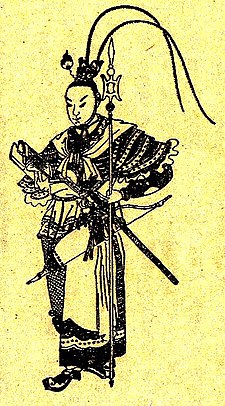
A Qing print, in which Lü looks skinny (according to some, a staple of Qing figurative style). But he's got the mandatory long pheasant feathers and the "Great Sky Slicer" halberd (方天画戟).


Shin Sangoku 2/DW3:
Shin Sangoku 3/DW4, beginning to get a bit darker:
And Shin Sangoku5/DW6, which is just wow(I don't think that's what people meant by "halberd"...):

So what, says the hypothetical reader. These crazy Japanese folks have decided to make more exaggerated costumes, big deal. But there are important differences in how the exaggerations have been made--always with some kind of hearkening to an ur-image or set of motifs based in textual record, but manipulated to cater to as wide a spectrum of historifandom's fan-consumers as possible, a spectrum that is no longer (if it ever was) merely a bunch of Hack 'n' Slash devotees who didn't give a thought what their avatars looked like as long as they could rack up KO counts. And the game isn't all nonstop mook-slaying; cutscenes and cinematics are progressively unlocked as the player slice-n-dices through hordes of enemies, and though the narrative merits of said scenes are questionable, they focus heavily on the heroes' character development (distortionment may be a more accurate term), embedded in historical context delivered by a solemn narrator. For example, Saika Magoichi's opening video.


There's a question worth probing here in relation to non-Asian consumption of the Musou games, which is "how much do American audiences 'get' of the historical stuff," and whether that makes their historifandom one that is weaker than Asian fans, who are presumably more in the know. First of all, of course Asian fans are not necessarily more knowledgeable about obscure, short-lived generals of the 200s CE or random daimyo and their henchmen in 17th-century Japan than are American fans, who may have knowledge sufficient for them to recognize Guan Yu or Hideyoshi and be attracted to the games in the first palace.

Returning to the "Americans aren't historifans" point, when the Musou games first arrived in the US, players were maybe as a whole more content to tolerate weird names and exotic outfits--not exactly something stunningly novel in the game industry--without thinking of them beyond the game, in a way accepting them as culturally "odorless" goods. This may still be the case for some. But the Musou games seem to have also prompted a search for, or at least curiosity in, the very much culturally specific and historically rooted "real" underneath the glossy CGI. For example, the large Koeiwarriors fansite forum (http://z13.invisionfree.com/koeiwarriors/) boasts a special sublevel, the "History Realm," dedicated to "various eras of history"--it's actually got more topics than any one of the other sublevels dedicated to specific titles of the Musou series.

While changing demographics and demands in fandom successfully reshape Koei's Gross Historical Distortion, history (with lesser or greater degrees of Gross Distortion) enters into the consciousness of fans and recalibrates their demands. Intuitively it seems kind of terrible to imagine hordes of 18-35 year-olds contributing to the terror that is Shin Sangoku 5's Lü Bu or Koutetsu Sangokushi's Zhuge Liang, but really, is what the "pros" do so very different? There's money, obsession, and distortion involved in the latter case, too, isn't there? Maybe academic historifandom seems more okay because there's less money and more book-reading entailed. Probably the same obsession, though, and distortions are willfully ignored or ruefully acknowledged, not delighted in and paraded around.

(*I'll need to muse a bit on why Japanese pop culture seems to like Wu so much when Shu, which controlled Sichuan, and the 中原, or Yellow River plain, was the narrative focus of RotK.)