Showing posts with label video games. Show all posts

2008/10/27

For the love of monkeys

When Carl "My Inspiration, Basically" Pyrdum at Got Medieval started posting about images of monkeys, I was inspired. Also, I laughed, cried, and gave it many thumbs up. And people should give him a super-duper Medieval Lit job.

But returning to my inspiration: I knew that someone had to do something about Chinese monkeys, and where better to start than with the Chinese monkey, the Great Sage Equal to Heaven齐天大圣, the mighty Sun Wukong 孙悟空, the Beautiful Monkey King 美猴王,the immortal Simian 猢狲himself!*

Behold! My fuzzy cheeks, my rosy glow, my large magical stick. Sorry, I'm a celibate Buddhist, and besides, the dude who created me invested in me the vices of Pride and Anger, not Lust or Gluttony.
(Image from the nostalgia-riffic mid-1980s CCTV show, with the opera star Liuxiao Lingtong as Mr. Sun)

The goal of this post is to take an initial look at some representations of the Awesome Ape** over time and in various media, and to muse about why a monkey, of all creatures, became the uncontested hero of this extremely influential story.*** In general, the trend seemed to be one of "domestication," especially considering that this block-print, dated by the authoritative Wikipedia to the 16th century, depicts a rather more bestial incarnation:
("Pilgrim Sun." Frontispiece from the oldest surviving copy of the Journey to the West, c. 1590.)

I am pretty sure that this isn't His Apeness way back before he learns human ways, because he's wearing clothes and has got his magical staff from the Sea Palace. In fact, this is probably supposed to beSun the Pilgrim (the label in the left margin says as much). So even in his role as protector and disciple of the sutra-seeking monk Tripitaka, Wukong looked a bit more au naturel. He's also blending in nicely with that peach tree behind him. Maybe the hairiness is a side-effect more of printing technology than of any initial visual type, but that would require looking at more illustrations from later copies, which maybe one day I can convince someone to pay me to do.

On the stage, Lord Monkey acquired a more standardized look. Here he is as the Great Sage, with the long partridge feathers of a warrior and the yellow robes of a ruler:

And here he is as a more modest Pilgrim en route to India with his master.

Dramatic****, coded facial makeup is emblematic of Peking opera in general, but note the decidedly nonhuman features highlighted by the contrasting red and white, and the orange fabric balls for extra-large monkey ears. But of course, these bold, recognizable colors and patterns are also a way to "tame" the hairy, bulgy-eyed Ape of earlier times into brightly-colored familiarity for theatergoers.

More recent iterations began to get creative. Witness Sakai Masaaki-san as the Sage in the 1978 Monkey [also Monkey Magic!] (or as I like to call it, "the more politically incorrect Journey to the West TV series"). Compare his relatively more "normal" skin and hair color to the CCTV Wukong, as well as the abstracted monkey-ness of the opera makeup.

Next comes the many faces of Goku from that venerable, ridiculous, and horrifically unattractive anime known as Dragonball***** that I nonetheless watched for lack of anything else (oh, bygone days when no American kid watched weird Japanese shows instead of hearty, patriotic, made-in-the-USA cartoons). The link (as far as I know) between this Goku (the Japanese pronunciation for "Wukong") and our favorite simian are tenuous. Apparently sometimes this one has a tail, and he can fly around on a cloud. Also, he is powerful. More interesting is that his hair grows really long when he enters "Super Saiyan mode"--a kind of lycanthropic (simithropic?) transformation, a bestial reversion maybe.
(AM I PORCUPINE OR MONKEY OR MAYBE A BUNCH OF POLYGONS??)

The tension between Wukong's conformation to Buddhist (or in some cases Daoist) tenets such as mercy and patience and his "wild," impulsive streak forms some of the central conflicts in Journey to the West, the primary one being between Monkey and his master Tripitaka. But how ironic that it seems to be this very "human" weakness of impatience and pride that is contrasted to the virtues of an actual human (Tripitaka)! Plus, as I'll discuss in more detail below, Tripitaka is not the hero of Journey--so it's really these "untamed" qualities of the Monkey King that attract our human admiration, even as his image was domesticated.

But of course then postmodernity and that dang globalized media thing has to go and screw the trend of domestication up (in that annoying half-assed postmodern way). So we got the anomaly of a pretty much human looking beefy hero named Goku who "reverted" by growing long bushy blond hair. Japan of the late 1990s brought us another charming version of Goku:

(Son Goku from the manga Saiyuki by Minekura Kazuya which, though not overtly ghei, is ghei by (many) implications.)

Bushy hair, check. Stick, check. Traveling-clothes, check. You don't know this, but occasional outbursts of violence in a weremonkeyish manner, also check. The weird thing is this Goku's childlike image; indeed, instead of being basically the only competent member of Tripitaka's little party, this Goku is kind of airheaded. It's Sanzou (Japanese rendition of Sanzang, in turn the Chinese rendition of Tripitaka) who's the cool operator. Then again, Sanzou uses a revolver to blast demons away while Hakkai (Bajie/Pigsy) is an emo one-eyed user of "ki blasts." So. Some revisionism here. What meaning does this have, aside from indicating the popularity of dark-drama manga that transcends traditional genre barriers? Unclear. But I should point out that Goku retains something apart from the obvious from the original novel--his asexuality. This is something that'll be important when I take a look at the history of monkeys in older folklore.

Here we have a Jet Li-Monkey from the recent Forbidden Kingdom, which I haven't seen but in which I am mildly and guiltily interested. The armor's been updated--no more tacky yellows and reds! It also has a bit of a Japanese look to it, but maybe it's supposed to be Tang-style. But importantly--nothing really very apelike about this Sage except for the hair. The more "natural" blond hair (as opposed to the heavy-duty goldenrod of the CCTV version), tied in a not-very-Chinesey tall ponytail. This man looks more like what a Chinese person who'd never seen a blond Caucasian might imagine one to be like (hairy, very hairy, with slightly sketchy grin) than an animal.
(Damn, that looks soooo itchy.)

And finally, Sun Wukong (as far as I am aware, he is known by this name and not Son Goku) from the very recently released Musou Orochi 2: Maou Sairin video game by the Japanese company Koei. His attitude resembles that of a surfer more than that of a Buddhist pilgrim, and he allies himself with the (eeeevil) monk Taira no Kiyomori, who takes Tripitaka's place in freeing the Monkey.

(Thanks to http://koeiwarriors.co.uk/ for the image.)

As far as I can tell, the Sage looks like (again) a "foreigner" with weird hair more than he does a monkey, tail aside (even the tail looks like an accessory and not a hint of a deep bestial nature). Perhaps coinciding with a man-objectifying trend I identified in a post some time ago, he's got a really impressive midsection.

To sum it up, from the initial publication of the Journey to the West to the twentieth century, it seemed like the general trend in image/imaginings of the Monkey King was one of codification and concomitant domestication. He was powerful, but not an object of terror. The narrative of the novel also concerns the Monkey's taming, of course. As some people who know vastly more than I will ever know about this have written, the Monkey's journey is one of being appropriated by the strictures of religion and made not only human but holy, rather like a Chinese St. Christopher.****** The Monkey of Journey is, however, the inheritor of two traditions, neither of which is quite as friendly. The first is that of the White Ape, whose legends mostly concern the kidnapping and raping of human women (some of whom apparently could be bestialized by the experience and "forget" their humanity). This obviously threatening figure is a target of men's attacks, and ultimately dies at their hands--a dangerous, racially distinct Other intent on "stealing" womenand subverting human society tameable only by violence. The ethnic quality of the White Ape's otherness seems especially striking when recalling the blondness of several of the images of the Monkey above, and particularly of the recent versions. Monkey-as-foreigner is thus one mode.

The other is that of the rebellious ape, a Titan-like creature born naturally of the earth and locked in battle with a god in the form of a young man. This monkey is not nearly as obviously evil or dangerous as the White Ape, and it's pretty clear that its attempts to usurp a "higher" authority are echoed in the Monkey's pre-pilgrimage exploits. Basically, then, the monkey was a symbol of conflict between chaotic earthly forces and lawful human ones--the pivot being a threatening sexuality, which, as I pointed out, Sun Wukong does not have. That, I think, is an important factor that puts him, and not the actually more human-looking Sandy (Shasen) or the actually human Tripitaka, in the role of the hero.

Sandy's in fact not a very central character in the party, so let me look more closely at Sun Wukong, Tripitaka, and Pigsy (Bajie/Hakkai) instead, because they represent three ways for the reader to identify with the action.

Tripitaka's the only human being--so there's a superficial level of self-recognition for the reader. Furthermore, he's the most spiritually accomplished in the human world-order of Buddhism. Of course, he's a sexual teetotaler, being a holy monk and all, but there's a crucial difference from Monkey's abstinence: he lacks sexual agency. It's not only his being a monk that emasculates him, but his personality (vacillating, credulous) and his looks (effete, and outright "tasty" to the various demons that try to eat and/or have sex with him). Not something a virile young reader would want to fully sympathize with.
(In some cases, Tripitaka has been actually played by an actress, as here in Monkey. Cute, though <3.)

Pigsy, on the other hand, is bestial, even monstrously so, and voracious in both sexual and literal appetite. He's the sins of greed and lust made obvious in a porcine package. His failings also include, however, incompetence at defeating demons/protecting Tripitaka (all of his abilities are explicitly described as inferior to Wukong's), and dishonesty. He's an aspect of human weakness, but the most repulsive one of these three main characters.


(I do recognize that pigs are in fact intelligent, cool animals. But most 16th-century Chinese probably didn't.)

Thus Monkey is the only one left to make our hero, and the fact that the first major section of the novel is actually all about Monkey's exploits only reinforces that link. For a contemporary reader Wukong didn't have the sexual "gross-out" factor of either looking too girlishly feeble or too disgustingly greedy. The motifs of sexual/racial threat are still in the imagination of His Monkeyness, but apparently neutralized into abstract representations of his identity as the Monkey.

It was the Royal Ape's very human self-discipline, capability, intelligence, along with his irrepressible impulsiveness and irreverence that made a perfect hero. Novels and print culture are associated with an early modern consciousness in Europe--though the appellation has only been controversially applied to China, maybe the Great Sage's intense individualism in the face of Confucian authority, along with his presence in a widely printed novel, could be an argument for a similar spirit in the Ming and Qing.


*He is a man(?) of many faces, of many passions, of many Risible and Old-Fashioned Literal Translations... [BTW, I am delighted to note that my Chinese input system automatically supplied these proper nouns. Even the computer is a fan.]
**Not an actual epithet, but one I am sure His Awesomeness would appreciate.
***If you need a refresher, or maybe just a fresher, on what the hell is going on here with the monkeys and pilgrimages and Buddhist satire, here's a rundown.
**** Badummmmp!
*****For sake of simplicity, have omitted other suffix letters (Z, S, etc.)
******See Whalen Lai's article, "From Protean Ape to Handsome Saint." 1994.

2008/09/04

Grab-bag Post

It's been quite a while, dear hypothetical reader. I bring you a variegated bonanza, or rather bonazette, of things.
1. Bits and pieces from the Internets
-I've been loving a series of videos find-able on Youtube called "The Japanese Tradition." Some are subtitled, some not. Best ones I've seen so far: Origami and Hashi (chopsticks).
-If ever your feminist/reasonable side needs a good laugh/cry/fury session, view this little diatribe at your own peril. Apparently the young gentleman attends Columbia, which is horrid (the fact that he's tainting the university, not the university), but then again I can recall certain incidents from my undergraduate career just about as sordid...

2. Books I am reading, books I have read, books I want
-Reading: Changing Clothes in China (pretty sweet so far), A College of Magics (rereading. As Jane Yolen says on the cover of my edition: "A large step up...from Harry Potter.")
-Read: Red China Blues, China Road, Firebirds: An Anthology of Original Fantasy and Science Fiction (Which one of these does not belong?)
AWK! AWWK!

-Should be reading: Pile of material for first week of class (aieeeeee), stack of two dozen books in the corner
-Lusting to read: Guyland, which seems fascinating, not to mention MANLY.

3. Other news
-Making headway in the fairly well-crafted PS3 game Folklore.

The significant other is playing Ellen (young braid-bearing woman whose lack of assertiveness is a bit annoying), and I Keats (spectacle man). It's very interesting how sometimes Europeanisms seems almost more outstanding in Japanese popular culture/imagination than American counterparts. Perhaps some kind of fairly reductive argument could be made about how Europe has more historical and cultural detritus and is thus more appealing to the Asian psyche, laden as the latter is with all that history and, you know, stuff. But it's also important to remember that, as crucial as the relationship between Japan and the US during and since the WWII era has been, that in the nineteenth century Europe was probably much more important as an Other for Japan, whether it be as a kind of enemy in sonno-joi (Expel foreigners, revere the Emperor) movements or as a role model of sorts in industry, government, and military affairs.

2008/04/14

Historifandom: Musou (Part 2)

After putting up the last installment, I had a discussion with a friend in which he suggested that perhaps I was overemphasizing the fannish appeal of the Musou games, viz. that the majority of players actually savor the games for the intuitive (read: idiotically easy) controls and mechanics, and the fantastic appeal of slaughtering thousands of polygonal enemies, not the satisfaction of seeing historical figures reduced to a delightful hodgepodge of over-the-top visual motifs.

It's probably true that the initial audience for the Musou series were more into das Hackenslashen than the, um, character-slashin', but over the years the game designers' own fannishness toward their heroes have become noticeably more prominent. As evidence I'll follow the evolution of Lu Xun, a general of the kingdom of Wu, historically married to the daughter of Sun Ce and most prominently known for his role in the capture and death of Guan Yu and his victory at the Battle of Yi Ling in 222 (see previous entry). Here he is in Shin Sangoku Musou, known as Dynasty Warriors 2 in the US (released 2000). [NB: The first Dynasty Warriors was a fighting game of the arcade face-off variety.]


And Shin Sangoku Musou 2/DW3 (note the hint of midriff) (2001):


Shin Sangoku 3/DW 4, a swing toward fuller coverage--possibly in tandem with a sweep of conservatism around the world? (2003):


Only to be countered with a decided turn for the bare-all (!) in Shin Sangoku 4/DW5 (2005 ):

And last, not least but probably fruitiest, I present Lord Lu as seen in this year's Shin Sangoku 5/DW6 for the PS3:
And have a closer glimpse of his tres chic eye makeup and feathers:
Certainly the constant improvements in 3D modeling capabilities have contributed to Lord Lu's image updates over the years, but it seems pretty clear that there's something else at work here, namely historifandom and its participants' concomitant power as consumers to actually mold the "canon" of their own fandom. And, since their canon is actually a bunch of characters from historical record reenacting actual events, they are revamping the understanding of history itself through its icons, re-imagining (or distorting, if you're less kindly disposed) the appearances and behavior of the long-dead for their own enjoyment and consumption. When a fan plunks down in 2008 to write a slashfic, would ze prefer a feathery, tribal-eye-tattooed Lord Lu to insert into hir steamy scenes or something more like this:

...they'd probably end up covering the poor fellow in sparkles and feathers anyway. Just like Nobunaga's ridiculous armor in the previous installment, I think Lu Xun's feathers and braids have some "real" roots--he was known as the pacifier of southern "barbarians," and since he hailed from the Eastern Wu (centered in the Jiangnan area), which was already coded as peripheral in the Romance of the Three Kingdoms, the whole exotic look kind of makes sense.* So there seems to be a general "fanon" model for Lu, and it looks a lot more like the Koei rendition--youthful, red-clad, associated with all things flaming (literally). In fact, I've got another indicator that historifandom is in fact going backward to influence corporate-produced canon, that in fact the two are becoming well-nigh inseparable in this our age of high-speed consumption:
[Screenshot from the 2007 show Koutetsu Sangokushi 鋼鉄三国志. Lu Xun on left, Zhuge Liang(!) on right ]

So consumers/fans are actively repatterning history to fit their tastes through popular culture, and apparently with more force than in previous decades. I'd call it Japanese popular culture, but a quick browse at your local chain bookstore or electronics joint will demonstrate that North American consumers are becoming a huge force in gobbling up fandom and fanculture. I do, however, think that the progression of Lu Xun's wardrobe reflects but one dimension of historifandom, that resonate with fangirl/腐女子 ("corrupt girl") culture, with its love of fruity men behaving suspiciously with other fruity men. A somewhat different fannishness has also prompted action on Koei's part--witness the case of Lü Bu, henchie of the warlord Dong Zhuo.

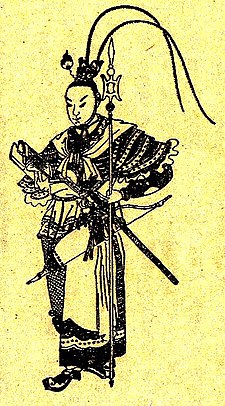
A Qing print, in which Lü looks skinny (according to some, a staple of Qing figurative style). But he's got the mandatory long pheasant feathers and the "Great Sky Slicer" halberd (方天画戟).


Shin Sangoku 2/DW3:
Shin Sangoku 3/DW4, beginning to get a bit darker:
And Shin Sangoku5/DW6, which is just wow(I don't think that's what people meant by "halberd"...):

So what, says the hypothetical reader. These crazy Japanese folks have decided to make more exaggerated costumes, big deal. But there are important differences in how the exaggerations have been made--always with some kind of hearkening to an ur-image or set of motifs based in textual record, but manipulated to cater to as wide a spectrum of historifandom's fan-consumers as possible, a spectrum that is no longer (if it ever was) merely a bunch of Hack 'n' Slash devotees who didn't give a thought what their avatars looked like as long as they could rack up KO counts. And the game isn't all nonstop mook-slaying; cutscenes and cinematics are progressively unlocked as the player slice-n-dices through hordes of enemies, and though the narrative merits of said scenes are questionable, they focus heavily on the heroes' character development (distortionment may be a more accurate term), embedded in historical context delivered by a solemn narrator. For example, Saika Magoichi's opening video.


There's a question worth probing here in relation to non-Asian consumption of the Musou games, which is "how much do American audiences 'get' of the historical stuff," and whether that makes their historifandom one that is weaker than Asian fans, who are presumably more in the know. First of all, of course Asian fans are not necessarily more knowledgeable about obscure, short-lived generals of the 200s CE or random daimyo and their henchmen in 17th-century Japan than are American fans, who may have knowledge sufficient for them to recognize Guan Yu or Hideyoshi and be attracted to the games in the first palace.

Returning to the "Americans aren't historifans" point, when the Musou games first arrived in the US, players were maybe as a whole more content to tolerate weird names and exotic outfits--not exactly something stunningly novel in the game industry--without thinking of them beyond the game, in a way accepting them as culturally "odorless" goods. This may still be the case for some. But the Musou games seem to have also prompted a search for, or at least curiosity in, the very much culturally specific and historically rooted "real" underneath the glossy CGI. For example, the large Koeiwarriors fansite forum (http://z13.invisionfree.com/koeiwarriors/) boasts a special sublevel, the "History Realm," dedicated to "various eras of history"--it's actually got more topics than any one of the other sublevels dedicated to specific titles of the Musou series.

While changing demographics and demands in fandom successfully reshape Koei's Gross Historical Distortion, history (with lesser or greater degrees of Gross Distortion) enters into the consciousness of fans and recalibrates their demands. Intuitively it seems kind of terrible to imagine hordes of 18-35 year-olds contributing to the terror that is Shin Sangoku 5's Lü Bu or Koutetsu Sangokushi's Zhuge Liang, but really, is what the "pros" do so very different? There's money, obsession, and distortion involved in the latter case, too, isn't there? Maybe academic historifandom seems more okay because there's less money and more book-reading entailed. Probably the same obsession, though, and distortions are willfully ignored or ruefully acknowledged, not delighted in and paraded around.

(*I'll need to muse a bit on why Japanese pop culture seems to like Wu so much when Shu, which controlled Sichuan, and the 中原, or Yellow River plain, was the narrative focus of RotK.)

2008/04/06

Historifandom: Musou (Part 1)

The other day I called home and had a slightly disheartening conversation with my kid brother:

ME: ...so, yeah, I'm doing Asian history.
BROTHER: (shocked) Asian history?
ME: Chinese in particular.
BROTHER: ChiNESE?

If I knew he could understand the joke, I'd call him a 汉奸. Oh well.

Now, kid brother is one of those chilluns who began gaming almost as soon as he could sit up unassisted. He adores RTS (real-time strategy) and turn-based games incorporating historical settings, such as Rome: Total War. But his first reaction, and, I think, that of a lot of people, is that history (and by extension historians) are inherently and irrevocably boring; the older the period, the more boring--yeah, yeah.

ME: But you campaign against the Celts and Germans every night, don't you? Isn't that cool?
BROTHER: (grudgingly) ...I guess so.

Second bias everyone's heard of: historical Asians are totally, like, boring! All Analects and test-taking and repression and famines, not to mention confusing names. Asian history's pretty dull as it's taught in East Asia, too (I can only speak for the PRC of the 90s, but somehow I doubt there's been much progress there or elsewhere in the neighborhood away from memorizing endless lists of names and filling in blanks therewith).

But some fanchildren out there know this ain't so, and in fact revel in making history (even premodern Asian history) their fandom. Of course, Asian historifandom's more common in Asia, but with the rise, especially since the mid-1990s, of North-American "otaku" culture that revels in all things Japanese (a topic that requires more updated research, for sure), there's a brand of unabashedly fannish, distinctly Asian pop culture that's begun to infiltrate the American market, which merges the historio-mythological with the sheer distorting glee of fandom in a whole new way.

In particular, there's Koei's Musou series, which began with the heroes of the Three Kingdoms (Sangoku Musou--Dynasty Warriors in English; the first was released in 1997), then recently added a new line about the Sengoku Jidai (Sengoku Musou/Samurai Warriors, first released in 2004). Unlike the Total War series, the Musou games are far less concerned with historical accuracy--indeed, the whole point of my posting on the games (apart from being obsessed with them, cough cough) is that they sell by deliberately distorting history. Emphasis on deliberately, because the characters are still recognizable, and, like in Total War, the player can choose to reenact documented battles and events. Other than that, at first glance the games seem to have taken rather little from recorded history. Have a look at this picture of Oda Nobunaga, as he appears in Sengoku Musou 2:
For comparison's sake, a more old-school rendering:

There's something fascinating about this contrast, for me anyway. Without knowing that the top image depicted a character named Oda Nobunaga, could anyone actually recognize him? Possibly. The Musou series' heroes are condensed symbols of their historical identities, in the same way that other forms of popular culture have reduced the complexities of heroes of history and myth into distinctive visual archetypes. Take Guan Yu for example. Here's a screencapture from a Chinese serial drama (Lord Guan's on the far left):
And as he appears in Peking Opera:

And finally, as seen in the latest Sangoku Musou game (released in the US just a month or two ago):
He's got the green color scheme, the "beautiful beard," and of course the 800-jin Blue Dragon Knife, just like the Romance of the Three Kingdoms says! Now, Nobunaga's case seems more extreme, probably because Nobunaga's a much more recent personality with less symbolic detritus (no Romance of the Sengoku Jidai)to link his identity to his appearance, or maybe because Koei's a Japanese company more at ease with distorting Japanese historical figures. Nonetheless, his purple-and-black look, the decadent feather ruff, the European cuirass, and the lightsaber do make sense. Missionary Jesuits were active in Nobunaga's time, and he made pragmatic use of them against his rivals, as opposed to his successors Hideyoshi and Tokugawa Ieyasu, who banned Christianity and began persecutions of converted Japanese, fearing the destabilizing potential of this imported faith. This Jesuit connection might explain the armor and cape. Nobunaga's ruthlessness and self-aggrandizement as "demon-king" (魔王, maou), whether factual or apocryphal, contributes to his evil-overlord look.

And does anyone really learn anything from this? Well, for one, that gross historical distortion (henceforth GHD) can show how the mythos of history, particularly that surrounding people, is formed and perpetuated, even in such 'crass" venues as video games. Moreover, the fact that the Musou games are popular and profitable (Koei's up to the 6th Sangoku Musou release in the US, just put out a "tactical" version of Sengoku Musou in summer 2007, and churned out Musou Orochi, a mind- and timeline-boggling combo of San- and Sengoku, last winter) reflects intriguingly on the consumers' side of historical production, too. The "hack-n-slash" gameplay, as most game review sites point out, is incredibly repetitive between new installments of the series; the cast of characters also remain generally the same. So there's something else gripping about the content--its appeal to historifandom's "historifantasies" through its reimagination and repackaging of these "boring" long-dead people into "awesome" heroes.

Sometime in the future I'd like to talk more about the sexualities at work in the Musou historifandom, the "alternate history" appeal of Musou Orochi, and of course more in depth on why and how the Musou characters are "awesome" in a specfically historifandom way.